
Applications / Paints, Coatings & Inks
Controlled Pigment Dispersion for Consistent Colour, Gloss and Print Performance
A good milling result is not defined by particle size alone. Colour strength, shade, gloss, viscosity, filterability and long-run wear must remain inside the production window.
We help match grinding media to pigment hardness, formulation viscosity, separator limits and the level of cleanliness the finished coating or ink requires.
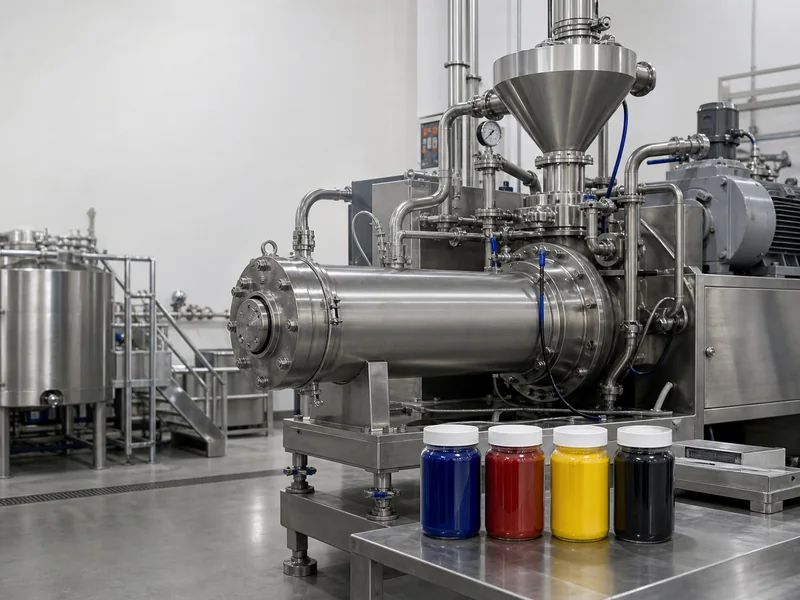
Why this application is demanding
The Endpoint Must Work in the Finished Coating or Ink
Pigments, fillers, resins and additives interact during milling. A formulation may reach the target fineness while still creating unstable viscosity, poor filtration or a costly coarse-particle tail.
Wetting and agglomerate break-up
Poor premixing leaves large agglomerates for the bead mill to handle. Very small media may then circulate efficiently but fail to deliver enough impact to break the feed.
Coarse tail and filter blockage
An acceptable average size can conceal oversize pigment or debris. That tail may reduce surface finish, block filters or disturb ink transfer.
Heat and rheology drift
Temperature, solvent loss, dispersant demand and growing surface area can change viscosity during a trial. Particle size should never be reviewed without the process conditions.
Media and mill wear
Wear can affect shade, opacity, filtration and equipment condition over time. Short trials should be followed by representative-duration checks before approval.
Process view
Build a Stable Dispersion Window, Not a Single Lucky Batch
Control each stage that can shift the final appearance, rheology or production rate.
Qualification matrix
Measurements That Make a Media Trial Useful
Agree on acceptance criteria before the test. The most useful endpoint connects the mill result with the way the finished formulation will be applied.
| Quality objective | What can go wrong | Useful trial evidence |
|---|---|---|
| Colour strength and shade | Dispersion improves at first, then shade shifts through over-processing, heat or wear-related pickup. | Compare drawdowns at fixed film thickness, substrate, drying conditions and colour-measurement method. |
| Fineness and coarse tail | D50 looks acceptable while oversize pigment, agglomerates or foreign material remain. | Combine PSD with a grind gauge, sieve or filter-residue check appropriate to the end use. |
| Gloss or transparency | Residual agglomerates scatter light, while excessive fines or formulation drift can also change appearance. | Use the same substrate, film thickness, application method and cure or drying schedule. |
| Viscosity and rheology | Temperature, solids, solvent loss or surface-area change makes batches difficult to compare. | Fix the viscosity method, spindle or geometry, shear condition, temperature and time after milling. |
| Filterability and cleanliness | Oversize particles, bead fragments or mill wear increase filter loading and product loss. | Record filter grade, pressure or time, residue mass and visual condition under equal batch volume. |
| Media wear and process cost | A lower purchase price is offset by bead addition, cleaning, downtime or rejected product. | Compare media loss and product quality at equal output, specific energy or representative operating time. |
Media selection
Choose the Grade Around the Formulation and Risk Level
All three media families can serve coatings and inks, but they address different balances of purity, impact energy, wear stability and cost.
HIGH PURITY / FINE DISPERSION
YSZ Beads
A common starting point for premium pigments, fine technical dispersions and products where low wear and stable colour matter more than minimum media price.
- High density and broad 0.1–20 mm range
- Small-media options for high contact frequency
- Suitable for demanding cleanliness targets
Review YSZ beads →
HIGH VISCOSITY / HARD FEED
Ce-TZP Beads
Dense, tough media for high-viscosity systems or difficult pigments where strong energy transfer and long-run mechanical stability are priorities.
- Approx. 6.2 g/cm³ density
- Standard 0.3–3.2 mm range
- Colour and chemistry fit require formulation testing
Review Ce-TZP beads →
GENERAL INDUSTRIAL / ECONOMICAL
Zirconium Silicate
A cost-conscious option for many waterborne coatings, conventional printing inks and mineral-filled systems with moderate wear and purity requirements.
- Approx. 4.0 g/cm³ density
- Standard 0.3–3.0 mm range
- Useful balance of performance and media cost
Review zirconium silicate →
Diameter strategy
Smaller Media Adds Contacts—Only If the Feed and Mill Support It
Bead diameter should be selected from the initial agglomerate size, target fineness, slurry viscosity and the separator’s reliable retention limit.
Fine and low-viscosity dispersion
Increase contact frequency
Smaller media can improve fine-particle interaction after effective wetting and premixing, provided the separator retains the full bead-size distribution.
General-purpose production
Balance impact and contacts
Mid-range media is often easier to separate and can provide a practical balance for common coatings and printing inks. Trial evidence should set the actual range.
High viscosity or coarse feed
Preserve impact energy
Larger or denser media may be needed to overcome slurry resistance or break tougher agglomerates before a finer finishing stage.
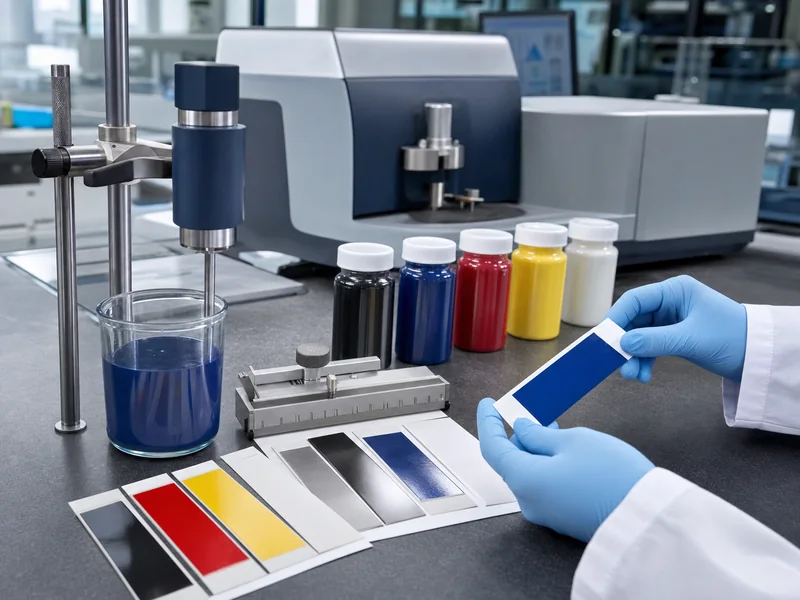
Quality-control handoff
Confirm the Dispersion in the Form Customers Will Use
A media trial is complete only when the finished formulation passes the agreed appearance, processability and stability checks.
- Colour strength and shade
- Gloss, transparency or opacity
- Grind gauge and coarse tail
- D10 / D50 / D90 where useful
- Viscosity at fixed conditions
- Temperature and solids content
- Filterability and residue
- Media loss and wear pickup
- Drawdown or print performance
- Short-term storage stability
Recommended validation
A Four-Stage Trial Before Production Conversion
Keep the formulation, operating window and quality checks fixed enough to isolate the effect of the grinding media.
01
Define the baseline
Record current media, formulation, feed fineness, cycle time, temperature and finished-product result.
02
Set equal conditions
Control batch size, solids, filling, speed, flow, cooling, sampling points and test methods.
03
Compare the full result
Review colour, fineness, viscosity, filtration, output and wear rather than one particle-size value.
04
Extend the run
Confirm bead retention, wear trend, cleaning and batch consistency across representative production time.
Application brief
Information that helps us review the process
- Paint, coating or ink type
- Pigment / filler and hardness
- Water-, solvent- or UV-based system
- Solids content and viscosity
- Feed and target fineness
- Mill model / chamber volume
- Separator type / clearance
- Current media and consumption
- Cycle time / throughput
- Colour and contamination limits
Start with your current process
Good Recommendations Begin with Constraints
Mill model, current bead, formulation type, feed condition and target result are usually enough to narrow a practical sample range. Missing details can be clarified before the trial.
Review Technical Guidance
Sample & application support
Build a More Reliable Pigment-Dispersion Trial
Share your formulation type, mill, separator, current media, viscosity, feed fineness and target result. We can help narrow the media family and diameter for controlled testing.