
Guidance of Grinding Media Selection
Use the correct property, calculation and trial method to reduce risk before changing bead chemistry or diameter.
Density alone does not predict wear, and bead price alone does not predict milling cost. This guidance connects material properties, separator compatibility, media charge and controlled testing to the actual production decision.
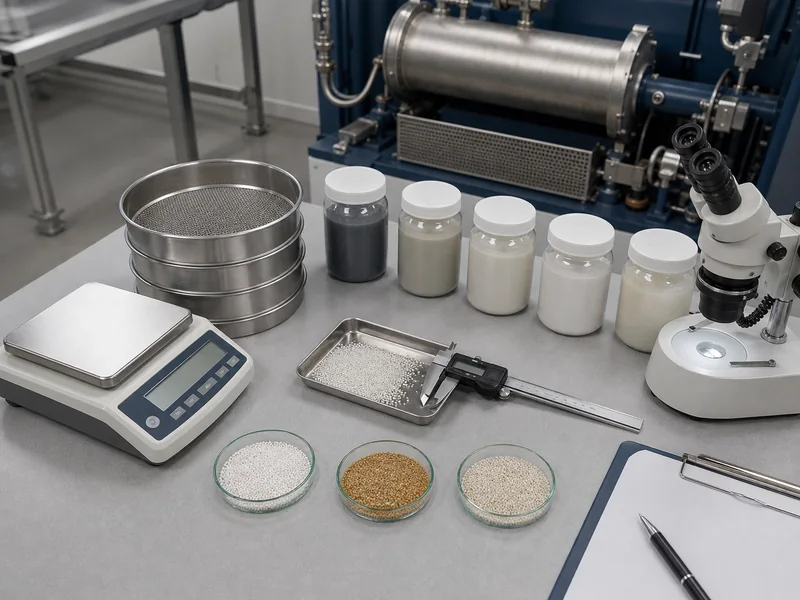
Four Inputs Before Choosing a Bead
A technically sound recommendation needs both the media specification and the conditions in which it will operate.
Material Chemistry
Identify acceptable elemental pickup, colour effects and any product-contact qualification requirements.
Particle-Size Duty
Record feed distribution, target D50/D90 and whether the process is pre-grinding or fine dispersion.
Mill & Separator
Confirm chamber type, rotor design, working volume and the screen opening or separation gap.
Operating Window
Review viscosity, solids, speed, filling ratio, flow, cooling and expected production time.
Density, Hardness, Toughness and Wear Are Not the Same
Confusing these terms is a common reason for selecting media from one number instead of the complete operating requirement.
Energy and slurry penetration
Higher bead density generally increases impact energy at equal diameter and speed. It does not automatically guarantee lower wear or a better final dispersion.
Resistance to surface deformation
Hardness helps resist abrasion, but extreme hardness without suitable toughness can still create chipping or equipment wear under severe impact.
Resistance to cracking and fracture
Toughness matters during repeated impact, especially in high-energy mills, hard feed and long production runs.
The result of material and process together
Actual media loss depends on chemistry, microstructure, slurry abrasiveness, speed, temperature, loading, separator and time—not the bead alone.
Balance Contact Frequency, Impact and Separator Retention
Smaller media increase the number of contacts available for fine dispersion. Larger media provide more impact per contact and can better address coarse feed or high slurry resistance.
Small diameter
Useful for fine dispersion when the feed has already been reduced and the mill is designed for small media.
Check: separator retention, viscosity, flow and risk of screen packing.
Balanced diameter
Provides a practical balance of contact frequency, impact energy and common separator requirements.
Check: current bead result, target D90 and chamber design.
Larger diameter
Useful for larger feed, pre-grinding or higher slurry resistance in compatible equipment.
Check: rotor clearance, impact on mill parts and attainable final fineness.
Estimate Charge Weight Using Bulk Density
This estimator calculates an approximate media volume and mass. Enter the mill’s working chamber volume, the intended filling ratio and the grade-specific bulk density supplied in the technical data.
Estimated mass (kg) = Media volume × Bulk density (kg/L)
Use loose bulk density—not sintered or specific gravity. Final filling ratio must follow the mill manufacturer’s instructions and trial conditions.
Enter the known values
Review the Correct Media Family
Use the product pages for grade positioning and size coverage, then request the current size-specific technical data for procurement qualification.
YSZ Beads
High-density yttria-stabilized zirconia for demanding purity, wear and small-media requirements.
- Sintered density ≥ 6.0 g/cm³
- Nominal sizes 0.1–20 mm
- Battery, electronics and fine technical milling
Ce-TZP Beads
Dense ceria-stabilized zirconia with a toughness-focused balance for viscous, hard and long-run duties.
- Specific gravity up to 6.2 g/cm³
- Nominal sizes 0.3–3.2 mm
- Colour and chemistry require grade-specific review
Zirconium Silicate
Economical mid-density media for routine industrial milling with moderate purity and wear requirements.
- Specific gravity approximately 4.0 g/cm³
- Nominal sizes 0.3–3.0 mm
- Coatings, inks, minerals and agrochemical SC
Zirconia-Alumina Composite
A composite media option to assess for routine industrial milling where cost, wear and process compatibility must be balanced.
- Review grade-specific density and size coverage
- Check aluminium-related contamination requirements
- Confirm performance through a representative milling trial
When the Result Changes, Check the Complete Operating Window
These observations identify useful questions; they are not a substitute for the mill manufacturer’s safety and operating instructions.
| Observation | Possible process causes | Checks before changing media |
|---|---|---|
| Slow particle-size reduction | Bead too large or too light for the duty, low filling, poor circulation, feed too coarse, viscosity outside the operating range | Confirm feed PSD, chamber load, flow, power draw, temperature and separator before changing chemistry. |
| High media consumption | Abrasive formulation, excessive speed, incompatible parts, bead chipping, thermal stress, poor-quality retained media | Inspect bead shape, fragments, mill components, temperature history and weight loss under a controlled time interval. |
| Screen or separator blockage | Bead too small, damaged media, agglomerated slurry, unsuitable flow or viscosity, incorrect separator condition | Stop and follow the mill procedure; inspect screen opening, retained media distribution and slurry condition. |
| Excessive product temperature | High speed, poor cooling, overfilling, excessive viscosity, restricted flow or long residence time | Review cooling capacity, flow, power, filling ratio and batch strategy before increasing media density. |
| Unexpected contamination | Media wear, chamber or rotor wear, feed impurities, cleaning residue or sampling error | Use baseline samples and analyse the elements that distinguish media, mill parts and raw materials. |
Measure Wear and Output Under Equal Conditions
Supplier wear values are useful for screening, but the actual slurry and equipment determine production behaviour. Record enough information to explain the difference.
Technical Questions Before a Trial
How should grinding bead size be selected?
Start with feed particle size, target D50/D90, slurry viscosity, mill design and separator clearance. Smaller beads increase contact frequency, while larger beads provide more impact. The mill manufacturer’s minimum media size remains a hard equipment constraint.
Can glass or alumina beads be replaced with zirconia at the same size?
Not automatically. Zirconia has a different density and can change power draw, heat generation, impact energy and component wear. Review speed, filling ratio, cooling and separator compatibility before conversion.
Which density should be used to calculate the media charge?
Use the supplied loose bulk density in kg/L. Sintered density or specific gravity describes the ceramic material and will overestimate the charge if used as though the packed bead bed contained no void space.
Why can actual wear differ from a supplier test?
Wear depends on the formulation, abrasiveness, mill, speed, temperature, filling ratio, separator, cleaning condition and time. Compare media under equal process conditions and measure both weight loss and relevant elemental pickup.
What is the main difference between YSZ, Ce-TZP and zirconium silicate beads?
YSZ is normally the first candidate for strict purity and fine technical milling. Ce-TZP offers high density and a toughness-focused balance for viscous or hard duties. Zirconium silicate is a mid-density economical option for suitable routine industrial processes.
Validate the Grade in Your Own Process
Request the current size-specific technical information and sample plan. Share the conditions that affect the recommendation; unknown details can be clarified during review.