
Applications / Pharma, Cosmetics & Advanced Materials
Fine Dispersion Where Purity, Surface Quality and Qualification Matter
In sensitive formulations, the useful result is not simply a smaller D50. Coarse particles, media-related pickup, viscosity drift, filtration, cleaning and finished-product performance must all remain within a documented process window.
We help narrow grinding-media chemistry and diameter for controlled trials. Regulatory or end-use suitability must be confirmed for the supplied grade and the customer’s complete process.

Three qualification lenses
The Same Bead Can Face Very Different Acceptance Criteria
Start with the finished product and its risk level. A suitable trial for a cosmetic pigment, oral suspension or functional coating may use different evidence even when the milling equipment looks similar.
PHARMA
Material contact and reproducibility
Particle distribution and redispersion matter, but so do cleaning, traceability and customer assessment of all process-contact materials.
- Active-ingredient suspensions
- Oral or topical dispersions
- Customer-defined elemental and contact limits
COSMETICS
Texture, colour and stability
Residual agglomerates may create visible specks, gritty feel, filtration problems or shade variation in premium formulations.
- Mineral and colour pigments
- UV-filter and speciality-powder dispersions
- Cream, serum and make-up bases
ADVANCED MATERIALS
Defect and functional-property control
A narrow, repeatable dispersion may support coating uniformity, printability or functional performance in high-value materials.
- Functional inks and coatings
- Ceramic, optical and electronic slurries
- Nano- and speciality-powder dispersions
Aerospace & high-performance ceramics
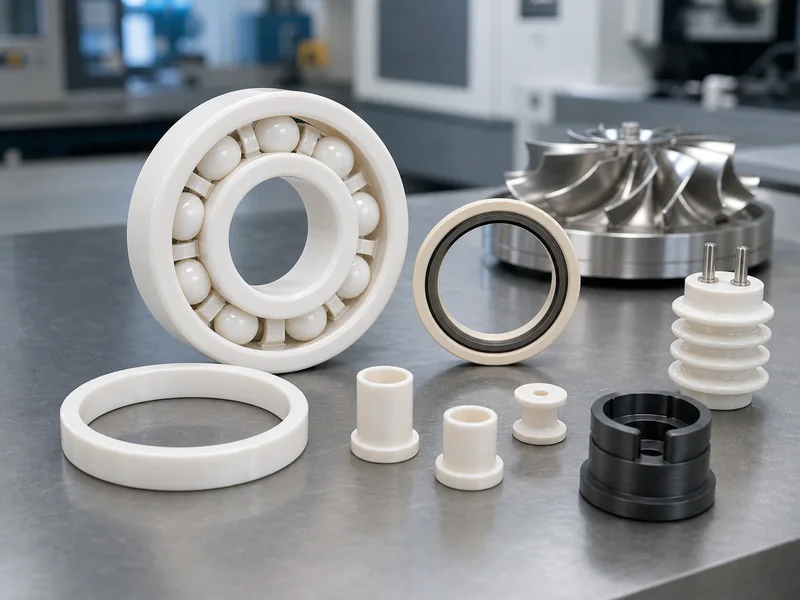
Slurry Control Carries Through to the Finished Component
For precision ceramic bearings, seals, insulators and structural parts, dispersion quality can influence forming uniformity, sintering behaviour, surface finish and the risk of local defects.
- Agglomerate break-up
- Slurry homogeneity
- Controlled media pickup
- Stable forming rheology
Why qualification is harder
Small Process Changes Can Reach the Finished Surface
Fine-particle processing increases contact area. That makes bead quality important, but it also makes the complete formulation and equipment system more sensitive.
A
Media and mill contamination
Wear products can accumulate gradually. Relevant elemental checks should compare the feed baseline, media chemistry and wetted mill components.
B
Coarse tail and agglomerates
An acceptable average size can conceal particles that create grit, filter residue, coating defects or visible surface variation.
C
Rheology and surface-area drift
Fines generation, temperature and dispersant demand may change viscosity or thixotropy before the target endpoint is reached.
D
Cleaning and cross-contact
Bead retention, chamber geometry, residues and cleaning method must be reviewed together before changing media size or product family.
Qualification boundary
No Regulatory Suitability Is Assumed
Grinding performance alone does not establish pharmaceutical, cosmetic or food-contact suitability. The supplied grade, its documentation and the customer’s process must be assessed for the intended market and route of use.
Customer qualification normally considers
- Supplied-grade identity and composition
- Relevant elemental or extractable limits
- Lot documentation and traceability
- Media-retention and fragment risk
- Cleaning and cross-contact controls
- Finished-product and market requirements
Process control points
Link the Media Trial to the Complete Qualification Path
Keep formulation, operating conditions and analysis fixed enough to isolate the effect of bead chemistry and diameter.
Qualification matrix
Evidence to Collect Before Production Approval
The useful endpoint must connect milling performance with cleanliness, processability and final application quality.
| Qualification objective | Potential failure mode | Useful trial evidence |
|---|---|---|
| Particle distribution | D50 reaches target while D90, oversize residue or excessive fines remain outside the useful window. | Track D10, D50, D90 and an agreed coarse-residue method at equal time or specific energy. |
| Relevant contamination | Media, chamber, rotor or feed background introduces elements outside the customer’s acceptance criteria. | Compare unmilled baseline and timed samples for elements linked to the media and wetted mill materials. |
| Appearance and texture | Residual agglomerates, colour pickup or excessive fines affect gloss, transparency, shade or tactile feel. | Use fixed drawdown, film thickness, substrate, drying and sensory or visual methods appropriate to the product. |
| Rheology and processability | Temperature, surface-area growth or additive demand changes filling, coating, printing or redispersion. | Record solids, temperature and a fixed viscosity or rheology method together with PSD. |
| Filtration and retention | Oversize particles, bead leakage or fragments increase filter load or reach downstream equipment. | Verify separator opening, media distribution, filter residue and retained-media condition. |
| Cleaning and batch control | Residues remain after discharge or the changeover method cannot be reproduced reliably. | Define cleaning sequence, inspection or analytical acceptance and lot-specific process records before scale-up. |
Media selection
Choose a Technical Candidate—Then Qualify the Supplied Grade
The three media families solve different energy, wear and cost problems. None should be treated as automatically suitable for a regulated product.
LOW WEAR / WHITE MEDIA
YSZ Beads
A common first technical candidate for fine, colour-sensitive or high-value formulations where wear stability and small-media options are important.
- High density and broad 0.1–20 mm range
- Small sizes for high contact frequency
- Still requires supplied-grade and process qualification
Review YSZ beads →
HIGH VISCOSITY / HARD FEED
Ce-TZP Beads
Dense, tough media for difficult, viscous or hard-material duties when strong energy transfer is required.
- Approx. 6.2 g/cm³ density
- Standard 0.3–3.2 mm range
- Colour and cerium-related pickup must be evaluated
Review Ce-TZP beads →
GENERAL ADVANCED MATERIALS
Zirconium Silicate
An economical option for suitable non-critical advanced-material or general cosmetic duties where moderate wear and purity are acceptable.
- Approx. 4.0 g/cm³ density
- Standard 0.3–3.0 mm range
- Not a default pharmaceutical-contact recommendation
Review zirconium silicate →
Diameter strategy
Small Media Is Useful Only When Retention and Cleaning Remain Controlled
High contact frequency can help fine dispersions, but the minimum practical bead size is set by the feed, viscosity, separator and acceptable retention risk.
Fine finishing
Start after effective premixing
Small beads are more effective when the feed no longer contains agglomerates too large for the available impact energy.
Separator control
Verify the complete bead distribution
Check the minimum supplied media size—not only the nominal range—against the separator and mill manufacturer’s limit.
Cleaning and recovery
Plan changeover before sizing down
Smaller media can increase population and retention difficulty. Recovery, inspection and cleaning should be part of the trial plan.

Finished-product handoff
Verify What the Next Process Actually Sees
A qualified dispersion must pass the measurements that matter to coating, filling, printing, sensory quality or the customer’s regulated process.
- D10 / D50 / D90 and coarse tail
- Relevant elemental pickup
- Filter residue and bead retention
- Viscosity at fixed conditions
- Colour, gloss or transparency
- Texture or grit where relevant
- Coating or print uniformity
- Storage and redispersion
- Cleaning acceptance
- Customer-defined functional result
Documentation & cleanability
Qualification Continues After the Milling Trial
For sensitive products, a successful particle-size result is only one part of approval. Documentation, change control and reproducible cleaning complete the decision.
SUPPLIED GRADE
Identity and certificate scope
Confirm that the composition and certificate information apply to the exact grade, size range and production lot being evaluated.
TRACEABILITY
Lot-specific records
Keep media lot, mill configuration, operating conditions and analytical results connected in the trial record.
CLEANING
Recover, inspect and verify
Define how beads, screens, chamber surfaces and transfer paths will be emptied and checked after changeover.
CHANGE CONTROL
Reassess meaningful changes
Media grade, diameter, mill materials, separator, formulation or acceptance method changes may require renewed review.
Recommended validation
A Four-Stage Qualification Trial
Keep the decision evidence tied to the exact supplied grade and the customer’s complete process.
01
Define restrictions
Document intended use, contact route, contamination limits, feed condition and relevant regulatory assessment.
02
Set equal conditions
Control formulation, filling, speed, flow, temperature, sampling points and analytical methods.
03
Measure trends
Compare PSD, rheology, contamination, filter residue, media loss and process stability through time.
04
Complete the handoff
Confirm cleaning, documentation and finished-product acceptance before production approval.
Application brief
Information that helps us review the process
- Product category / intended use
- Powder or active chemistry
- Carrier and additive system
- Solids content / viscosity
- Feed and target PSD
- Mill model / chamber volume
- Separator type / opening
- Current media and diameter
- Relevant contamination limits
- Required grade documentation
Start with the qualification question
Technical Fit and Regulatory Fit Are Separate Decisions
We can help narrow media chemistry and diameter for a controlled test. The customer remains responsible for determining whether the supplied grade and process meet the intended product and market requirements.
Compare Grinding Media
Sample & qualification support
Build a Documented Media Trial for Your Sensitive Formulation
Share the formulation category, mill, separator, current media, feed PSD, target result and relevant cleanliness limits. We can help define a practical starting sample and trial checklist.