
Applications / Battery Materials
Stable Grinding Media for Cleaner, More Uniform Battery-Material Slurries
Battery-material milling is judged by more than the final particle size. Purity, particle-size distribution and repeatability across a long production run must be considered together.
Low-wear YSZ media is evaluated to reduce the risk that bead wear introduces unwanted contamination or causes performance to drift as milling time increases.
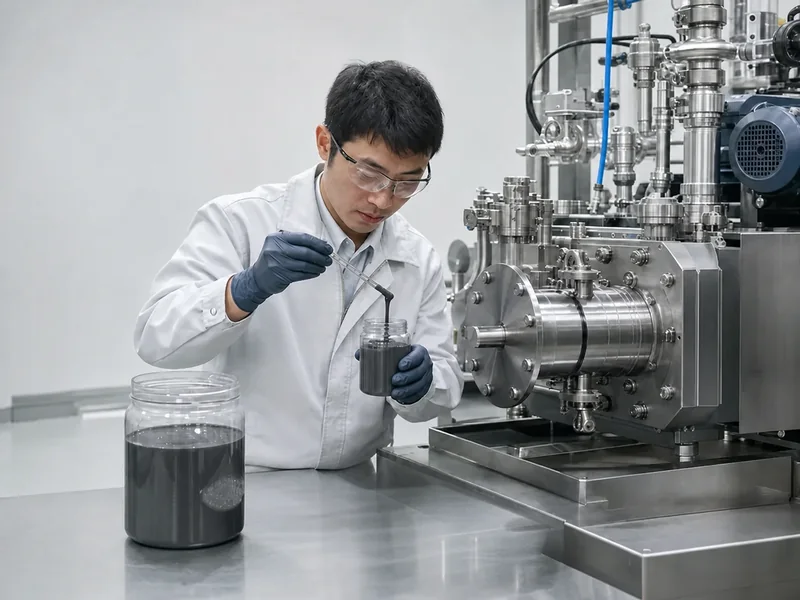
The real question is not only “Can the mill reach the target D50?” It is “Can it reach the target repeatedly without purity or distribution drifting during a long run?”
A practical media evaluation should track the process over time, not rely on one endpoint sample.
Why media wear matters
A Small Wear Rate Can Become a Large Process Concern
During wet milling, every bead experiences repeated impact, friction and contact with the chamber and separator. In battery materials, gradual wear can matter because the acceptable contamination window is often narrow and the production run may be long.
A
Purity risk accumulates
Media-derived particles may build up over time. The relevant result is therefore the contamination trend across the run, not only the condition of fresh beads.
B
Particle-size distribution can drift
Changes in bead surface, geometry or population affect contact frequency and energy transfer, which can widen the distribution even when an average value looks acceptable.
C
Scale-up exposes weak assumptions
A short laboratory test may not reproduce separator load, heat, circulation or residence time in production. Media selection should be validated under representative conditions.
Process view
Follow the Slurry, Not Just the Bead Specification
Media performance should be assessed at the points where the slurry can change. This keeps the discussion tied to your material and mill rather than to a single catalogue number.
Application decision matrix
What to Verify Before Production Scale
The appropriate bead size and operating window depend on the material, mill and acceptable contamination limit. The checks below help structure a useful trial.
| Process objective | What can go wrong | What to verify during the trial |
|---|---|---|
| High product purity | Wear products accumulate gradually and remain in the slurry after separation. | Analyze relevant elements at the start, during the run and at the endpoint; compare with an unmilled baseline. |
| Uniform particle size | An acceptable D50 can hide a coarse tail or excessive fines. | Track D10, D50 and D90 together, and compare the distribution width at equal specific energy. |
| Stable long runs | Temperature, viscosity, pressure or bead condition changes after the initial test period. | Record timed samples, mill pressure, temperature, throughput and media condition over representative duration. |
| Reliable separation | Beads are too small for the separator gap, or circulation becomes unstable. | Confirm separator clearance, retention behaviour, pressure trend and any bead leakage before sizing down. |
| Repeatable scale-up | Laboratory residence time and energy density do not match production conditions. | Compare specific energy, chamber geometry, cooling and circulation rather than copying speed alone. |
Why YSZ is considered
Media Stability Must Support the Entire Milling Window
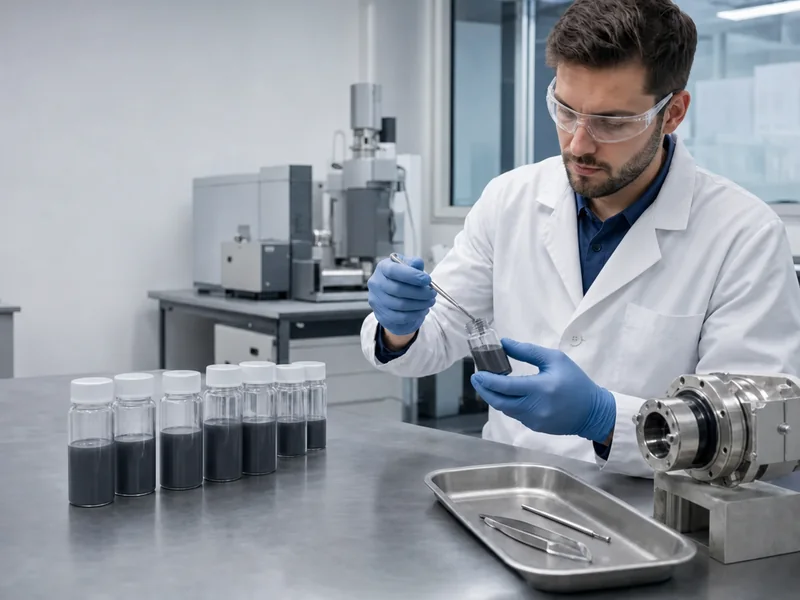
Yttria-stabilized zirconia is commonly evaluated for battery-material slurries because its high density, tough ceramic structure and smooth spherical geometry can combine efficient energy transfer with low-wear operation.
Recommended validation
A Four-Step Trial for Lower Selection Risk
A controlled comparison is more useful than a general wear claim. Keep the acceptance criteria visible from the beginning.
01
Establish the baseline
Document feed chemistry, initial PSD, target PSD, purity limits and the current media result.
02
Define equal conditions
Fix slurry concentration, media loading, temperature window, flow and sampling intervals.
03
Measure over time
Track PSD, relevant elemental contamination, energy input and process stability at timed points.
04
Scale with evidence
Select the size and operating window only after both output quality and long-run behaviour are acceptable.
Application brief
Information that helps us review your milling task
- Cathode, anode or precursor chemistry
- Solvent and solids content
- Feed PSD and target D10/D50/D90
- Mill model and chamber volume
- Separator type and clearance
- Current bead type and size
- Relevant contamination limits
- Typical run duration and throughput
A useful starting point
Send the Process Details You Already Have
You do not need a complete data package to start. A current media size, mill model and target particle-size distribution are enough for an initial review. We can then identify the missing checks before recommending a sample.
Sample & technical support
Validate Purity and Stability Before You Commit
Tell us the material, target distribution, current media and mill conditions. We will help narrow the bead-size range and define a practical comparison trial.