
Industry application solutions
Grinding and Dispersion Media for Diverse Industrial Processes
Match ceramic grinding media to the purity, viscosity, feed hardness, target particle size and economics of the actual application.
Battery slurry, coating pigment, electronic ceramic powder and non-metallic minerals place very different demands on a bead. Our application approach begins with the process risk—not a one-size-fits-all product claim.
4 media familiesDifferent purity, density and cost positions
6 application groupsFrom high-purity to high-volume duties
Trial-led selectionConfirm with the real mill and slurry
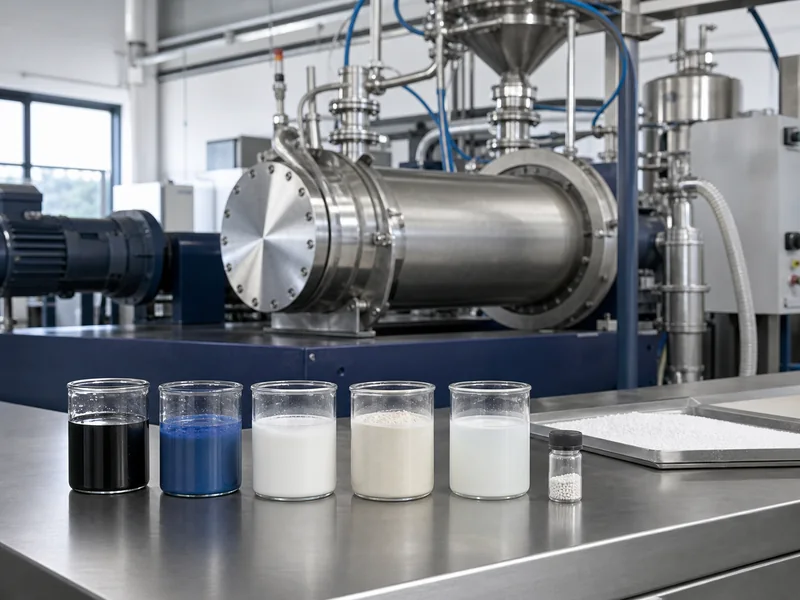
What changes between industries
The Application Defines the Real Selection Priorities
The same bead can perform well in one formulation and poorly in another. These four constraints normally determine the first trial candidates.
Product Purity
Elemental pickup, colour carryover and media wear must remain inside the finished-product specification.
Slurry Resistance
Viscosity, solids loading and feed hardness determine how much bead mass and impact energy are useful.
Target Fineness
Fine dispersion needs frequent contact, but the bead must still be safely retained by the separator.
Production Economics
Throughput, media loss, cycle time and product yield matter more than purchase price alone.
Application areas
Start With Your Material and Process
Each of the six application groups now has a dedicated page covering its process priorities, media-selection logic and practical trial criteria.
01 / HIGH PURITY
Battery Materials
Long-duration milling of cathode, anode and conductive materials places strict demands on wear stability, particle-size consistency and contamination control.
- LFP, NMC and related electrode materials
- Submicron dispersion and narrow PSD
- YSZ usually the first qualification candidate
02 / DISPERSION
Paints, Coatings & Inks
Pigment wetting, colour strength, gloss and filtration performance depend on stable dispersion without excessive temperature or media wear.
- Industrial and automotive coatings
- Printing and inkjet inks
- Choice ranges from economical silicate to dense zirconia
03 / PRECISION POWDERS
Electronic Ceramics & MLCC
Fine ceramic slurries require controlled chemistry and particle-size distribution while preserving the functional material system.
- Barium titanate and dielectric slurry
- Piezoelectric and technical ceramics
- Separator-compatible small YSZ media
04 / FORMULATION
Agrochemical Suspension Concentrates
Small-media circulation and repeatable dispersion are important for low- to medium-viscosity SC formulations and storage stability.
- Pesticide and crop-protection SC
- Fine dispersion without screen loss
- Silicate or zirconia selected by purity and wear limits
05 / HIGH VOLUME
Minerals & Paper
Large-volume wet grinding must balance media consumption, energy input and throughput for the required product fineness.
- Ground calcium carbonate and kaolin
- Titanium-dioxide and mineral dispersion
- Zirconium silicate for suitable general duties
06 / QUALIFICATION
Pharma, Cosmetics & Advanced Materials
These applications require customer-specific qualification of material contact, cleaning, contamination and regulatory documentation.
- Active ingredients and nano-dispersions
- Cosmetic pigments and speciality powders
- No regulatory suitability assumed without documentation
Media starting matrix
Common First Candidates by Application
This is a screening reference, not a substitute for testing. Product-contact regulations and customer specifications always take priority.
| Application | YSZ | Ce-TZP | Zirconium Silicate | Zirconia-Alumina Composite |
|---|---|---|---|---|
| Battery materials | First candidate Purity and small-media capability | Trial Only when cerium pickup is acceptable | Usually not first Silicate and wear limits require review | Grade-specific review Review aluminum pickup and grade suitability |
| Paints, coatings & inks | Trial High purity or fine premium products | Strong candidate Viscous pigment and long production runs | General duty Cost-sensitive routine formulations | Grade-specific review Compare grade-specific wear and pigment compatibility |
| Electronic ceramics / MLCC | First candidate Controlled chemistry and fine media | Trial Qualification depends on formulation | Usually not first Silicate pickup may be unacceptable | Grade-specific review Confirm chemistry and aluminum pickup limits |
| Agrochemical SC | Fine / strict grades When wear and contamination are critical | Trial For suitable viscous or long-run systems | General duty Economical low- to medium-viscosity SC | Grade-specific review Validate formulation compatibility and wear |
| Minerals & paper | Specialised Premium product or difficult target | Hard / viscous feed When density and toughness are useful | General duty High-volume suitable mineral grinding | Grade-specific review Evaluate wear, throughput and cost in a controlled trial |
| Pharma / cosmetics | Qualification start Document and validate the supplied grade | Qualification trial Check chemistry and cleaning requirements | Usually not first Use only after formal suitability review | Grade-specific review Use only after documented end-use qualification |
Application qualification
Information That Changes the Recommendation
A useful recommendation should explain why a chemistry and diameter fit the process. Send what is available; unknown details can be narrowed during the review.
- Material and formulation chemistry
- Viscosity and solids content
- Mill type and chamber volume
- Separator screen or clearance
- Current bead material and size
- Feed particle size and target D90
- Relevant elemental pickup limits
- Batch, circulation or continuous process
Controlled application trial
Compare the Complete Milling Result
When two media are technically plausible, a controlled trial provides better evidence than density or price alone.
Step 1
Hold Conditions
Keep formulation, speed, filling ratio, flow and temperature as consistent as possible.
Step 2
Measure Output
Record throughput, D50/D90, viscosity, colour or dispersion quality and processing time.
Step 3
Check Media
Measure weight loss, breakage, separator deposits and relevant elemental pickup.
Step 4
Calculate Economics
Compare media and operating cost per tonne of acceptable finished product.
Application support
Start With Your Mill and Material
Share the process conditions you already know. We can help identify a sensible media chemistry, diameter range and sample plan without pretending that every application has the same answer.
Useful details to include
- Application material
- Mill and separator
- Current media
- Viscosity / solids
- Feed and target size
- Purity limits
- Trial quantity
- Annual consumption